
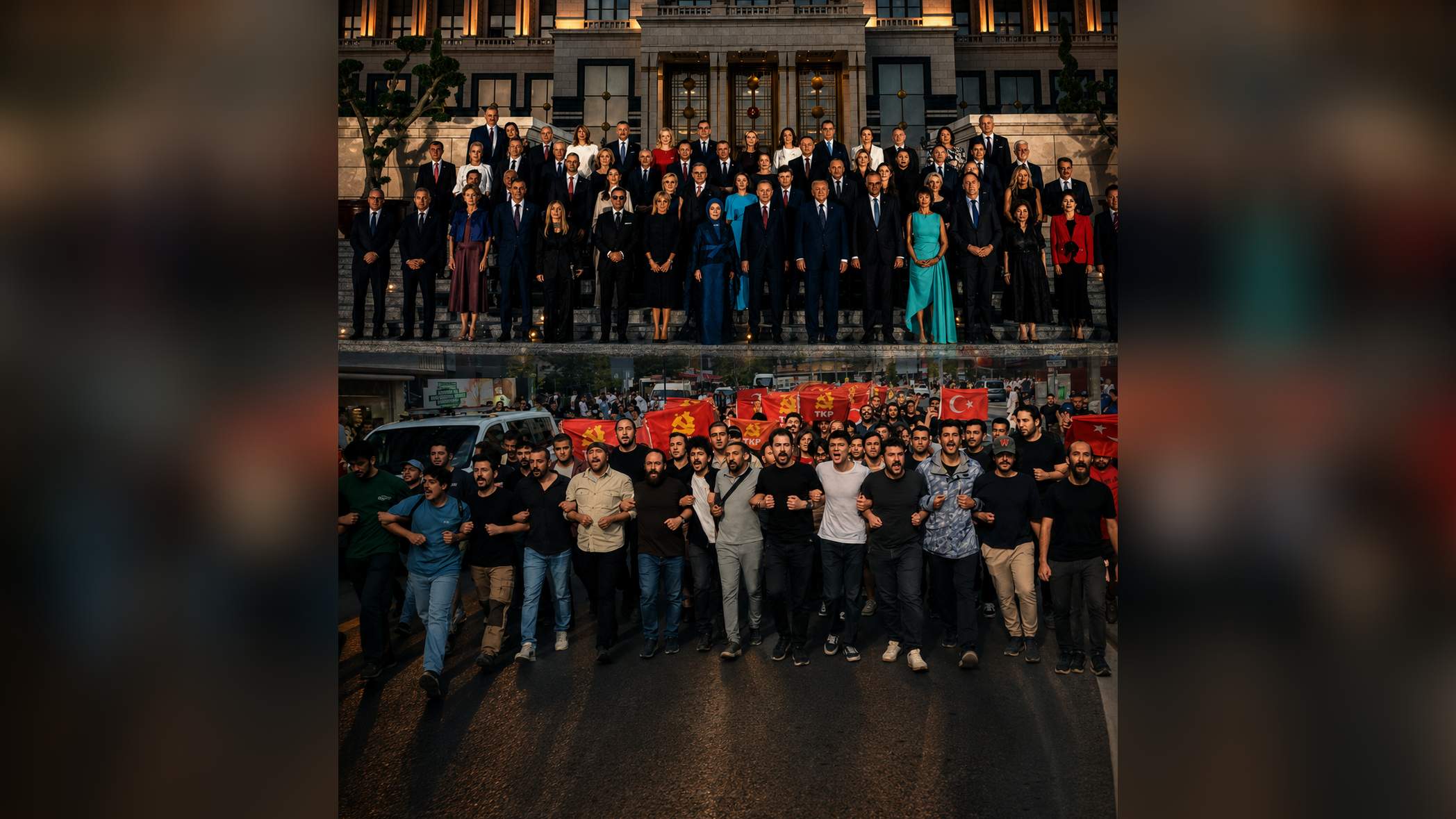
The Communist Party of Turkey issued a political note analysing of the situation, following the NATO Summit held in Ankara, Turkey. The note is entitled "The Reality of NATO After the Ankara Summit."
TKP assesses situation after NATO Summit
1. It was founded in 1949 with a great lie. Over the years, they have piled lie upon lie. It is now 2026, and the lies have piled up like a mountain. It should be known that NATO is an aggressive organization built on lies.
2. NATO was founded by imperialists who decided to destroy the growing influence and prestige of the Soviet Union and communism—which had liberated half of Europe by defeating the fascist German armies in a fierce struggle during World War II—through a new war. When NATO was established, the USSR was not threatening any country and was trying to heal its wounds after the loss of 27 million lives and the near-total destruction of its cities. NATO is the central headquarters of the new world war initiated by the US and Britain immediately after the end of World War II.
3. Turkey's inclusion in NATO in 1952, along with Greece, was not, as claimed, aimed at protecting these countries against the Soviet threat; rather, it aimed to encircle and militarily pressure the USSR, making anti-communism the official ideology in these countries and ensuring the inviolability of market economies and pro-Americanism.
4. Since its establishment, NATO has organized covert and illegal activities in member countries; it trained personnel for these activities. Secret networks established by NATO committed political assassinations, directed drug trafficking, organized provocative actions, and, when deemed necessary, planned coups or encouraged coup plotters to overthrow governments.
5. NATO is imperialism; NATO is the guardian of multinational monopolies and the system of exploitation; NATO is anti-communism. NATO is also a tool for the United States to maintain its hegemony within the imperialist system.
6. After the collapse of the USSR, NATO's priorities changed, but its essence remained the same. Despite the end of the Warsaw Pact, which was formed in response to the establishment of NATO under Soviet leadership, NATO continued to exist and even expanded eastward. This expansion is a product of the US and its allies' aim to fill the deep void created by the collapse of the Soviet Union and the profit-seeking of multinational corporations. Capitalist Russia has been encircled and squeezed in this direction. The war in Ukraine today is the result of the Russian Federation's response to NATO's challenge, possessing sufficient resources, military power, a capitalist class, and a strategy to shape a specific geography according to its own interests, thus avoiding acceptance of this encirclement.
7. In this context, the war in Ukraine is both a continuation and qualitatively different from the armed interventions and occupations led by NATO in countries such as Yugoslavia, Afghanistan, and Libya. The other examples were interventions aimed at consolidating US hegemony rather than countering a power that threatened it. The war in Ukraine, however, was launched as part of the US strategy to neutralize Russia and prevent the rise of China. For Russia, the war represents defending its interests in a region it considers its own sphere of influence, rather than solidarity with China.
8. NATO has never been an alliance without contradictions or tensions. Even during the period when the USSR existed, when NATO presented a more unified image against the "enemy," the divergence of interests between the US and the European imperialist countries was still observable . The competition among leading European countries themselves can also be added to this. However, European countries, led by Germany and France, never possessed the strength or vision to question US hegemony.
9. The US administration's prioritization of the Pacific to halt China's rise is not Trump's personal preference. The need for a shift in US strategic planning had been documented in numerous documents during previous administrations. Trump accelerated this process and, despite its inconsistencies, brought European imperialists to a point where they were receptive to this change. European countries, particularly Germany, which had established deep-rooted collaborations with Russia, especially in the energy sector, rapidly turned to a sharp hostility towards Russia with unparalleled folly. Trump's threats of "We are withdrawing from Europe, protect yourselves" facilitated the acceleration of NATO members' arms race. While prolonging the Ukraine War in a way that would weaken Russia, the US was simultaneously forcing European imperialists to allocate resources for the war and compelled them to act in concert with it.
10. NATO, which was absurdly said to be "falling apart" before the Ankara Summit, continues its bloody journey despite all its internal contradictions. The summit showed that the shared appetite for armament is the main glue holding NATO together. The budgets allocated to war have led large capital circles, primarily arms monopolies, to unconditionally support militarist policies in pursuit of new investment areas.
11. The AKP government prepared for the summit it would host in Ankara with the same enthusiasm. The Turkish arms industry, which for years had used the hot conflicts in Syria, Iraq, Libya, and the Caucasus as a laboratory, had recognized the radical transformation on the battlefield early on and managed to quickly move from its infancy to its running phase. Although sometimes embellished with unfounded exaggerations and distortions, it was clear that the "defense industry" had become one of Turkey's critical and leading sectors during the AKP's rule.
12. However, as arms companies flourished, the obstacles facing the sector also grew. First and foremost, the Turkish economy as a whole had a serious resource problem. As long as this problem remained unresolved, "success" was limited and risks increased. Even though the government had steered the ship further towards the Atlantic, both politically and economically, the problem continued to make itself felt in all its dimensions.
13. The AKP prepared for the summit calculating that assuming more central roles in NATO would improve Turkey's economic and political relations with Europe. NATO's European wing needed troops. Furthermore, European countries lacked the production capacity to meet the demands of the weapons and ammunition required by the Ukraine War and their war plans. Turkey, on the other hand, had become a cheap and fast supplier in some areas. In short, NATO, in addition to its well-known "benefits," would also serve as a key to strengthening relations with the West for our capitalist class. Therefore, during the NATO summit, visuals related to "domestic and national" weapon systems were displayed all over Ankara.
14. However, the issue wasn't simply about showcasing weapons and ammunition. In terms of arms production, an era had come to an end. Necessary collaborations and the procurement of high-tech components were hampered by obstacles stemming from sanctions dating back to Erdoğan's "Hey, America!" rhetoric. Turkish arms companies, having made a showy entry into foreign markets, were forced to obtain NATO certifications and participate in programs within the organization to maintain their presence. An arms industry that couldn't carve out a niche for itself in foreign markets and achieve stability couldn't possibly write a "success" story. Therefore, the Ankara Summit would be used both to improve relations with Western imperialists using the arms industry, and through these relations, the arms industry would overcome certain limitations.
15. In this context, the summit in Ankara was largely successful for the AKP. Lifting sanctions will take time, there will be two steps forward and one step back, and it will never be completely finalized. However, NATO's need for Turkey has increased. Therefore, the impact of these sanctions will diminish, and Turkey's role within the alliance will increase.
16. The limits of the Greek bourgeoisie's ability to prevent Turkey's increasing role within NATO, in competition with Turkish capitalism and regional rivalry, were once again demonstrated at the Ankara Summit. Greece's objections to Turkey, in cooperation with France regarding access to natural resources in the Mediterranean, ultimately served to provide additional bargaining chips to powerful imperialist countries aiming to bring Ankara to a certain line. While tensions between Greece and Turkey have real roots in the exploitative classes dominating both countries, they are ultimately used as an instrument by the US and UK to control these countries and the region. The US's tactic of arming Turkey at one time and Greece at another, increasing its military presence in both countries to create a sense of "devaluation" in the other, is a well-known but often effective method.
17. The Ankara Summit is a declaration of consensus on “armament” and “preparation for war.” The resistance of a few individual states, which are reluctant to provide arms to Ukraine or allocate resources to the targeted level of armament should not be given too much importance. What should be considered is the extent to which Europe possesses the infrastructure and economic potential to allow for the necessary transformation for rapid armament. Political, demographic, and economic obstacles that will hinder the steps taken by many European countries, primarily Germany, towards transitioning to a war industry are evident. While the EU's decline in the fierce global competition is a given, declaring these countries economically “dwarfs” is certainly unrealistic. However, a militarization on the scale declared by the ruling classes of these countries will inevitably have serious social costs. Further cuts in public spending, the militarization of working conditions, and the suspension of some fundamental freedoms under the pretext of a “threat of war” could lead to unexpected reactions from the working class. These costs could trigger developments that will turn Turkey's ambition to conquer Europe under the NATO banner into a fiasco.
18. Furthermore, as has been frequently stated, the US administration's intention in persuading the European side to rearm is not for Europe to establish its own arms industry. Washington's aim is to sell more weapons to Europe. Therefore, in the near future, fierce competition will emerge between arms monopolies for each purchase within NATO. Although Turkey wants to emerge victorious from this competition by engaging in "joint projects" with as many countries as possible and by sacrificing some state-owned companies to "big" players, in some cases it will face harsh interventions from monopolies unwilling to share the pie with a new actor.
19. What somewhat alleviates this competition is the scarcity observed in the market for many critical weapons. There is insufficient supply to meet the demand from NATO countries for items such as missiles, fighter jets, and artillery ammunition. Contracts for the sale of these weapon systems are signed years in advance, money transfers are made, and buyers wait for their turn. The AKP government recognized this scarcity years ago and has gained an advantage in some respects.
20. The fact that the development of "domestic and national weapon systems" was triggered by sanctions from the US and other countries is only one side of the coin. On the other hand, the current commitment to integrating this accumulation into the NATO alliance, the partnership agreements being signed, and new projects necessitate a closer examination of the role of countries like Canada and the UK in the emergence of "domestic and national weapon systems." This role can be considered not merely a commercial pursuit, but also the product of a strategic calculation.
21. The summit, which was "successful" for the AKP and the capitalist class, poses great dangers for our people and our country. It is important to list, first and foremost, the risks and uncertainties stemming from the summit's failures or unresolved issues. We have pointed out some of these problems above. However, the biggest problem for our country is the possibility of being drawn into hot conflicts. The Ukraine War and the aggression against Iran have become central to NATO's agenda. In this context, Turkey has officially become a party to the conflict. The direction in which both conflicts will evolve is uncertain. The AKP government is lavishly squandering its relations with these two neighboring countries amidst this uncertainty.
22. The unfriendly attitude displayed by government officials and AKP media towards the Russian Federation and the People's Republic of China for some time now, while symbolically significant for the time being, should be taken seriously as it aims to prepare public opinion for the government's actual steps in the same direction. Interestingly, no change has been observed in the approaches of these two countries towards Turkey that would explain this shift in attitude. The deterioration of Turkey's relations with China and Russia will have a number of negative consequences for our country and our people.
23. The US and NATO face formidable obstacles in achieving their goals in Ukraine and Iran. When these obstacles become more apparent, the price for Turkey will be paid not by arms monopolies and the capitalist class as a whole, but by our people.
24. Although not mentioned in press statements or the final communiqué of the Summit, it is clear that the new NATO headquarters announced by officials to be established in Turkey will lead to Turkey becoming a direct party to further tensions. The fact that one of these headquarters is related to the Straits increases the gravity of the issue. It is extremely dangerous for the government to engage in actions that twist the Montreux Convention from all sides and sacrifice it to NATO interests.
25. The AKP's attempt to implement its Neo-Ottoman strategy under the auspices of the US and NATO is another threat. This threat stems not only from the fact that a suitable regional environment will be shaped for a reactionary structure that has completely severed its ties with the Republic. The praise of the Ottoman Empire and calls for monarchy by US officials should be seen not only as an expression of revenge for 1923, but also as an expression of the desire to more easily control this region. Here, a Turkey driven by imperial aspirations, increasing its influence under the NATO umbrella, and even expanding its borders, will simultaneously become more fragile and will also activate the dynamics of disintegration. Growth and contraction, inflation and disintegration form a dialectical whole, and in every case, it means "war." This destruction, which will have an unparalleled impact on the working people, will also become an existential issue for our country.
26. The vast geography targeted by Neo-Ottomanism is witnessing fierce competition. This competition could spiral out of control at any moment. Leaving Iran aside, in this region, Turkey oscillates between partnership and enmity with other US allies, Greece and Israel. In a world where friendships and enmities are determined by the pursuit of profit, and where the interests of the capitalist class dominate the foreign policies of countries, our citizens suffer from both these so-called friendships and enmities. In the imperialist world, friendships are harbingers of other enmities. Neo-Ottomanism is dragging our country into darkness internally and chaotic conflicts externally.
27. While the dangers posed by NATO are evident, the fact that mainstream politics, with the exception of a few personal stances, is entirely pro-NATO is further proof that the struggle against imperialism and its organizations like NATO must be based on a class struggle. NATO is not only an imperialist alliance centered on the US, but also the international policeman of capitalist dominance. The opposition to the established order has once again demonstrated, in a dishonorable way, through its silence during the summit, that it is impossible to stand against NATO without confronting the market economy.
28. The Communist Party of Turkey's years-long struggle against NATO and its efforts to bring this dangerous organization to the attention of our citizens are related to all these realities and are an expression of its determination to create an independent, sovereign, and socialist Turkey by liberating our country from the domination of multinational monopolies, holdings, and imperialists. Our party has acted not with a "protesting" or "opposition" identity, but in pursuit of equality and justice, and has displayed an honorable stance despite all the pressure during the summit. This stance will only find its true meaning when our country leaves NATO and NATO leaves our country. Until that day, we will not compromise an iota in our struggle against NATO. We call on workers, laborers, and patriotic intellectuals to join the ranks of the TKP to strengthen this struggle.
TKP Central Committee