
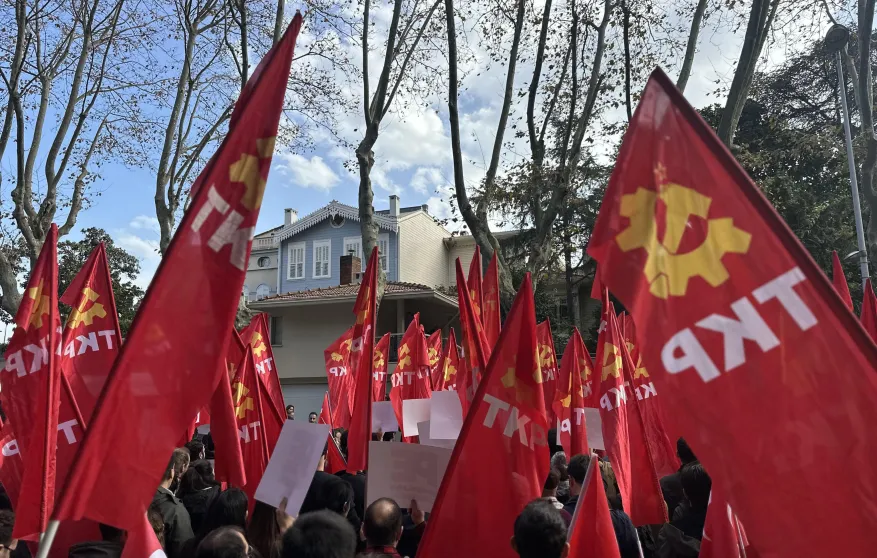

The Communist Party of Turkey (TKP) continued its campaign demanding accountability for the deaths of workers at the HABAŞ iron and steel plant in Aliağa, İzmir, with a demonstration outside the Istanbul residence of the company’s owner, Mehmet Rüştü Başaran, on 14 November.
TKP demonstrates outside HABAŞ owner’s mansion
Hundreds of TKP members and supporters marched along the coast from Yeniköy in Istanbul’s Sarıyer district to Başaran’s mansion, where they gathered under heavy police presence. The demonstrators chanted slogans including “We are on the bosses’ heels”, “Do not bow down, hold the killers accountable” and “Murder in the factory, luxury in the mansion”.
Speaking on behalf of the demonstrators, TKP Central Committee member Selahattin Kural said the party had come directly to the residence of the HABAŞ owner to demand accountability for the workers killed at the company’s factory. He rejected the treatment of the disaster as an isolated workplace accident and accused the company’s owners of having accumulated their wealth through the exploitation of workers and disregard for their lives.
Kural criticised the fact that Başaran, detained following the disaster, had been placed under house arrest rather than remanded in custody. He argued that the workers’ families and the wider public were entitled to justice, and declared that the company’s owner would have to answer to the workers and the people.
Nineteen workers killed in the Aliağa disaster
The demonstration recalled the catastrophic explosion and fire that struck the HABAŞ iron and steel plant in Aliağa on 9 November. The disaster initially left 17 workers dead, but the death toll subsequently rose to 19, after seriously injured worker Abdullah Kılınç died in hospital on 11 November. Six other injured workers were still receiving hospital treatment according to reports published on 12 November.
The explosion caused extensive destruction at the factory and left families struggling for hours to obtain reliable information about their missing or injured relatives. The handling of the disaster and the difficulties faced by families in identifying the victims also drew criticism.
The incident took place against a background of previous fatal accidents at the same plant. Hakan Doğan died in a workplace accident on 21 October, while Eyüp Eğinli died on 5 November, just four days before the explosion. These deaths have intensified questions about workplace safety, maintenance and the company's responsibility for conditions at its facilities.
The investigation led to the detention of 11 suspects, including Başaran and several senior managers and technical personnel. Nine were subsequently remanded in custody, while Başaran and one other suspect were released under judicial control measures involving house arrest. The investigation is continuing, and responsibility for the disaster has yet to be established through the judicial process.
“How was this wealth accumulated?”
In his speech outside the mansion, Kural also drew attention to working conditions across HABAŞ enterprises. He accused the company of subjecting workers to low wages, long working hours and humiliating treatment, while its owner enjoyed an extravagant lifestyle.
He questioned how such wealth had been accumulated, arguing that it was created through the labour of workers who were paid poorly and exposed to dangerous conditions. He also referred to the deaths of workers in other HABAŞ workplaces and demanded that the company's entire record be examined.
Kural called for HABAŞ to be taken into public ownership and for its owner to be arrested. He argued that the company's wealth should serve society rather than remain in private hands. The party's demand for the nationalisation of all HABAŞ enterprises without compensation had already been set out in its Central Committee statement of 10 November.
TKP links the disaster to government policies
The demonstration also broadened its criticism beyond the company's owner to the government and the political and economic policies that, according to the party, protect large employers.
Kural argued that the government's economic and political orientation was compatible with the interests of major capitalists, allowing employers to expand their profits while workers continued to die in preventable workplace incidents. He connected this criticism to the government's foreign policy and its pursuit of what he described as a “Neo-Ottomanist” political course, arguing that the interests of powerful business groups and the government's regional ambitions were intertwined.
Referring to the deaths of more than 35,000 workers over 25 years, a figure cited in his speech, Kural said that workers were facing a continuing struggle against employers and the political forces that protect them. He called on workers, pensioners, women and young people to organise and unite in the struggle for accountability.
“We will hold both the government and the bosses accountable,” was the central message of the demonstration.
The action outside Başaran’s mansion followed TKP’s immediate response to the disaster. On 9 November, the party organised a protest in Aliağa, while its members visited the factory and hospitals, sought information and expressed solidarity with the victims’ families. On 10 November, TKP staged a further demonstration outside HABAŞ’s headquarters in Istanbul and demanded the nationalisation of the company's enterprises. On 12 November, members of TKP and the Communist Party of the Netherlands staged a protest outside the conglomerate's Amsterdam office.
Through the latest action, the party has extended its campaign directly to the company's owner, insisting that the deaths in Aliağa must not be reduced to a temporary public controversy or an investigation limited to technical failures. TKP maintains that the struggle must address the working conditions and economic system that put workers’ lives at risk.