
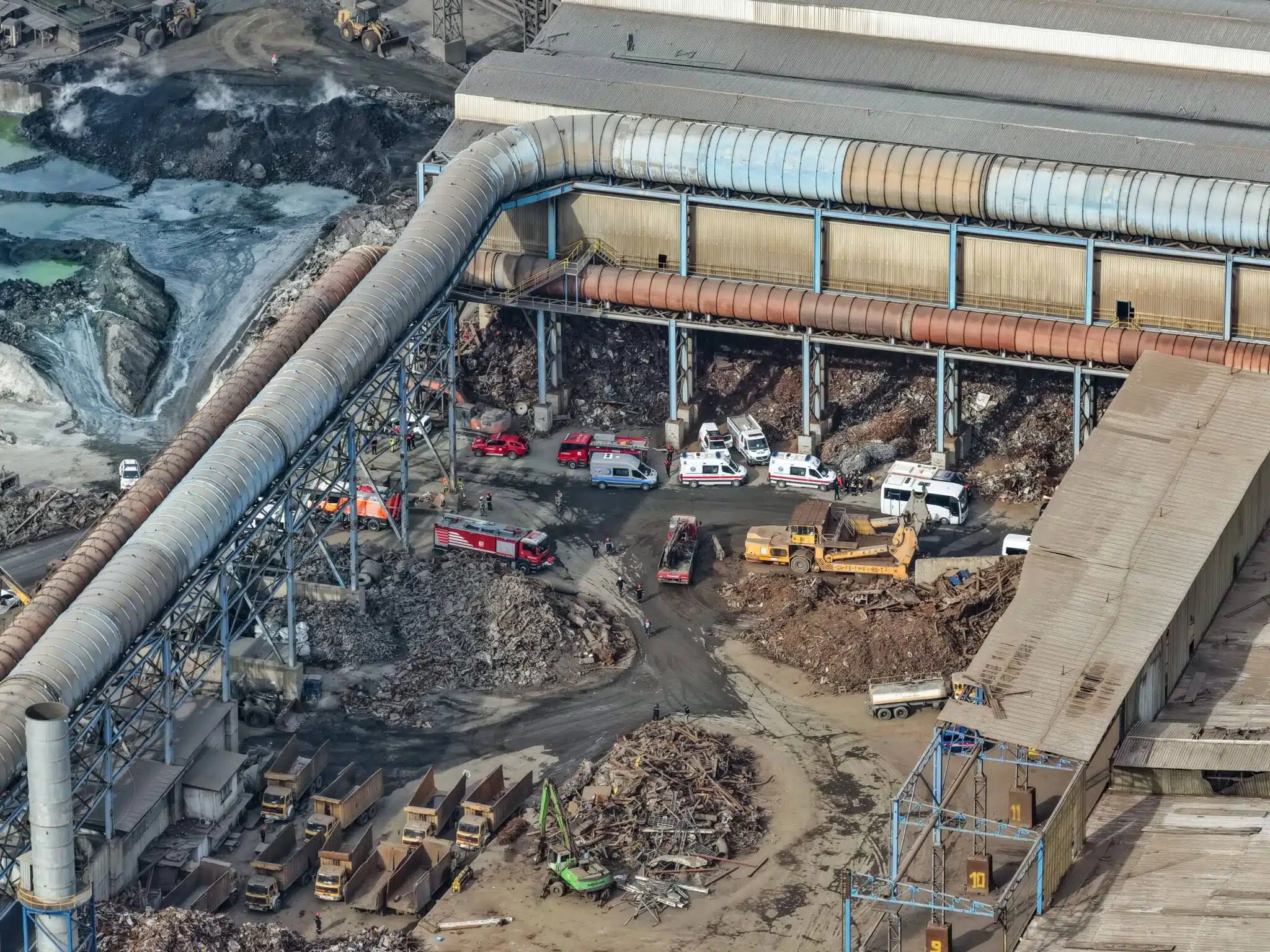
The Communist Party of Turkey (TKP) has published a detailed report examining the explosion at the HABAŞ Iron and Steel Plant in Aliağa, İzmir, on 9 November, which killed 19 workers and injured dozens more.
Image
Communist Party of Turkey publishes detailed report about HABAŞ disaster that caused 19 workers' lives
TKP publishes detailed report on HABAŞ disaster, points to safety failures and inadequate state inspections
Drawing on the experiences of HABAŞ employees and the families of the victims, assessments by specialists and expert institutions, and information published in the press, the report examines the technical causes of the disaster, the factory's working conditions and the shortcomings of Turkey's occupational health and safety inspection system.
The report argues that the disaster cannot be understood as an isolated industrial accident. It points to a chain of technical failures, warnings that were allegedly not acted upon, inadequate maintenance and inspection procedures, and a system in which responsibility for workers' health and safety is effectively left in the hands of employers.
A chain of equipment failures behind the explosion
The report draws particular attention to the preliminary expert assessment of the accident. According to the reconstruction cited by TKP, the disaster began when the fixed beam supporting the crane runway became detached from its column connections while a reserve furnace vessel was being transported. The crane and the vessel it was carrying then fell onto the platform of the electric arc furnace.
The falling equipment caused severe damage to the natural-gas installation and oxygen pipes in the area. Gas escaping from the damaged system subsequently ignited, producing the massive explosion and fire.
The expert assessment cited in the report emphasises that the incident cannot be explained solely by the actions of the crane operator or a mechanical failure of the crane itself. The safety of the supporting structure—including its design, manufacture, installation, maintenance and inspection—must also be examined.
TKP's report identifies several possible contributing factors, including metal fatigue and thermal stress, inadequate periodic maintenance, deterioration of structural connections and possible failures in safety sensors and automatic shutdown systems. It also raises questions about the adequacy of emergency evacuation routes and protective barriers.
The party further asks whether the natural-gas installation had been properly designed, inspected and approved, and whether the relevant checks were carried out by İzmirgaz.
Repeated warnings allegedly ignored
One of the report's most significant findings concerns warnings made by occupational safety specialists at the factory before the disaster.
According to records cited from the preliminary expert report, an occupational safety specialist, Selim Köse, had made recommendations on several occasions:
- 25 April 2025: preparation of periodic equipment maintenance and inspection lists, with proper records.
- 25 December 2025: provision of equipment for maintenance, establishment of a work-permit system and maintenance planning.
- 25 February 2026: periodic maintenance of cranes and steel structures, including non-destructive testing where necessary.
- 9 June 2026: further recommendations for periodic maintenance and inspection of cranes and steel structures.
TKP argues that these repeated warnings were not adequately acted upon. It also notes that 37 occupational safety specialists were reportedly employed at the facility, raising questions about their authority and ability to ensure that identified risks were addressed.
The report describes a fragmented system of occupational health and safety services at HABAŞ, involving permanent factory personnel and specialists supplied by external occupational health and safety units for subcontractors. It argues that these specialists ultimately operated under the control and supervision of the factory management, limiting their independence.
TKP questions whether risk assessments, emergency plans and work-permit procedures were actually implemented or merely maintained as paperwork.
State inspection statistics raise further questions
A substantial part of the report examines official data from the Ministry of Labour and Social Security's Guidance and Inspection Board.
According to the ministry's 2025 figures cited by TKP, the board conducted 8,906 occupational health and safety inspections during the year. Only four of these inspections were classified as having been carried out following workplace accidents.
The report highlights an even more striking figure: none of the 8,906 inspections was recorded as an accident- or occupational-disease-related inspection in the metal sector, despite the sector's high level of industrial risk.
TKP also examines the size of the enterprises inspected. In 2025, only nine workplaces employing more than 1,000 workers were included in the relevant programmed inspections of the metal sector. These represented just 0.36% of the total workplaces inspected under that programme, according to the party's calculations.
For comparison, the report cites official records showing that 1,931 workers died in workplace fatalities in Turkey in 2025, including 73 in the metal sector. It argues that the extremely limited inspection of large industrial enterprises raises serious questions about the state's ability and willingness to supervise workplaces where thousands of people are employed.
The party also questions the Ministry's statements following the HABAŞ explosion. On the evening of 9 November, Labour Minister Vedat Işıkhan said that the factory had been inspected several times and that no particularly serious problems had been identified. TKP argues that the public has still not received sufficient information about the nature and results of those inspections.
Demands for transparency and accountability
The report calls for the full publication of the technical expert assessment, relevant inspection records, witness statements and other evidence concerning the disaster. It also demands clarification of the inspections conducted at HABAŞ before the explosion, particularly following the deaths of two other workers at the same facility in the preceding weeks.
TKP argues that the existing occupational safety framework leaves too much responsibility in the hands of employers and private service providers. For particularly dangerous heavy-industrial facilities, it proposes that the Ministry of Labour directly appoint qualified and effective occupational safety specialists.
The party places the disaster within its broader criticism of Turkey's industrial and economic policies. It argues that the steel industry is strategically important and that major industrial enterprises should be brought under public ownership and operated according to a central plan, rather than being organised primarily around private profit.
The report's political conclusion is that the deaths at HABAŞ cannot be separated from the wider organisation of production and the weakness of public oversight. TKP says it will continue working to establish the causes of the disaster and hold those responsible accountable. The party's wider political demand is public ownership of strategic industrial enterprises and production organised in the public interest.