
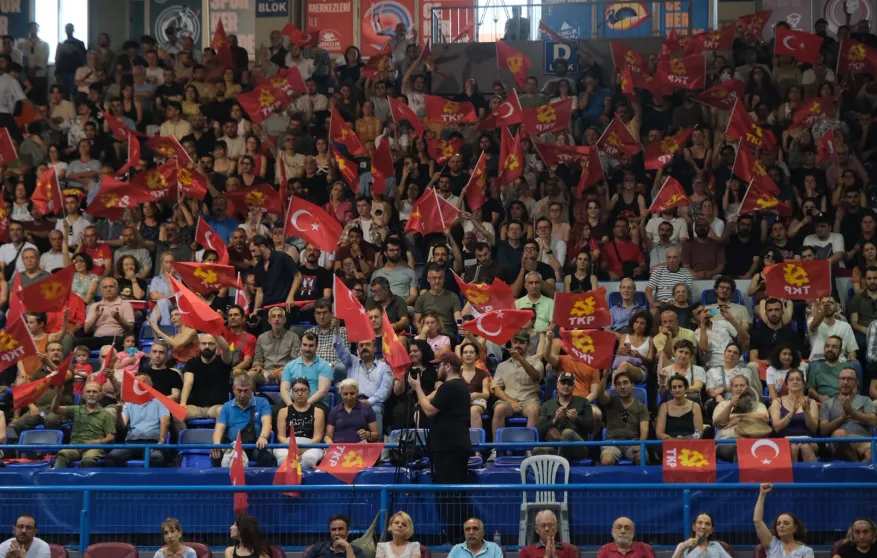
In Istanbul, hundreds of people gathered at the Kadıköy Caferağa Sports Hall at the call of the Communist Party of Turkey (TKP) to protest against the NATO Summit to be held in Ankara on 7-8 July. Speaking at the event, TKP General Secretary Kemal Okuyan stated, "We will not allow this country to have a NATO Summit in silence."
TKP will not allow a quiet NATO Summit
The event was held amid continuing demonstrations against the summit and included participation from Panista workers, who have been engaged in a labour struggle for several weeks. The programme also featured cultural performances, including a reading of Nâzım Hikmet's poem About the 23-Cent Soldier by Nazlı Deniz Korkmaz and musical performances by Gülcan Altan.
The event opened with a speech by Giorgios Marinos, member of the Politburo of the Communist Party of Greece (KKE), who expressed solidarity with the TKP's campaign against the NATO Summit. Marinos condemned the Turkish government's ban on demonstrations in Ankara, describing NATO as an anti-communist alliance that has historically served capitalist interests. He argued that NATO's post-Cold War expansion continues to threaten the peoples of the region and stated that the accession of both Turkey and Greece to the alliance in 1952 benefited their respective ruling classes rather than their populations. He called for stronger cooperation between the communist parties of the two countries and emphasized the importance of working-class internationalism in opposing NATO and imperialist policies.
TKP General Secretary Kemal Okuyan followed with a speech focusing on Turkey's relationship with NATO and the domestic political implications of the summit. He argued that Turkey's accession to NATO in 1952 represented a defeat for the country's independence and working people and maintained that NATO has been responsible for military interventions, coups and political instability throughout its history. Referring to the restrictions imposed in Ankara ahead of the summit, he accused the government of effectively imprisoning the city's residents in order to ensure the event proceeds without opposition.
Okuyan also criticized a broad range of political forces for what he described as their silence regarding NATO. He argued that political Islamists, nationalists and social democrats have failed to oppose the alliance despite frequently using anti-imperialist rhetoric in other contexts. According to Okuyan, the ruling AKP presents itself as pursuing an independent foreign policy while remaining fundamentally aligned with NATO and the United States. He rejected arguments that Turkey should remain in NATO for security reasons and reiterated the TKP's demand that the country withdraw from the alliance.
Addressing broader political issues, Okuyan linked opposition to NATO with opposition to imperialism, neoliberal economic policies, religious reaction and what he described as the government's expansionist foreign policy. He argued that the Republic of Turkey was founded on anti-imperialist principles rather than expansionist ambitions and criticized the current government for departing from that tradition. He also warned that increasing militarization in Europe and NATO's role in the war in Ukraine were heightening the risk of wider conflict.
Concluding his remarks, Okuyan pledged that the TKP would continue mobilizing against the NATO Summit despite the bans on demonstrations and other restrictions. He stated that the party would not allow the summit to take place without public opposition and affirmed that the campaign against NATO would continue throughout the country. The event concluded with slogans opposing NATO and supporting the struggle against the alliance.