
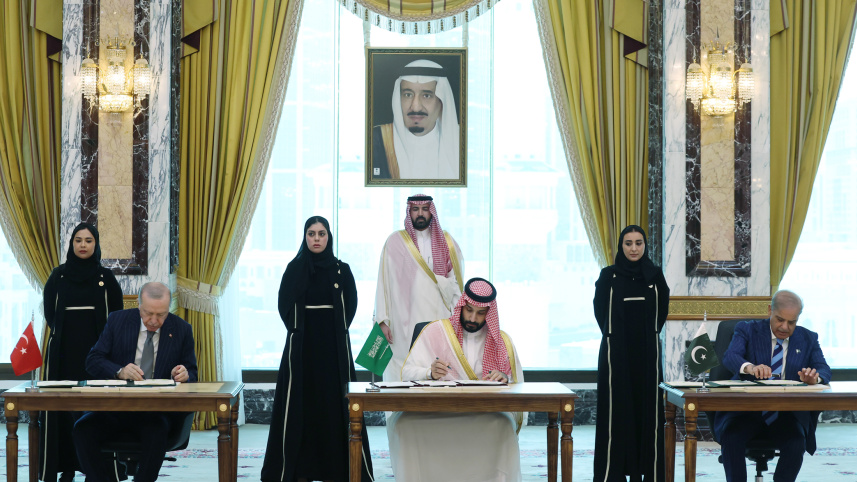

The Communist Party of Bangladesh (CPB) has strongly warned against the government’s intention to join the Mecca Joint Defense Agreement signed by Pakistan, Turkey and Saudi Arabia, describing the move as highly dangerous and a serious departure from Bangladesh’s tradition of an independent foreign policy.
Communist Party of Bangladesh warns against Mecca Agreement
The CPB has expressed concern that even before Bangladesh has received a formal invitation to join the military alliance, several ministers and advisers of the government have publicly expressed an interest in becoming a member. According to the CPB, such a move could expose Bangladesh to multiple political, security and geopolitical risks.
In a statement issued on 3 September 2026, CPB President Kazi Sazzad Zahir and General Secretary Abdullah Al Kafee said that Bangladesh’s own defense capabilities, its non-aligned position, economic strength, the unity of its people and an independent foreign policy constitute the principal foundations of the country’s national security.
The CPB leaders said that, rather than strengthening these foundations, joining a military alliance could draw Bangladesh into wars and conflicts originating elsewhere, either directly or indirectly. They stressed that Bangladesh must not allow its own security interests to be compromised by becoming involved in conflicts and geopolitical rivalries in distant regions.
The statement further emphasized that economic, commercial, labor-market, technological and defense cooperation are fundamentally different from membership in a military alliance. In the present conflict-ridden international environment, any attempt to make Bangladesh part of a military bloc and thereby constrain its strategic independence must be resisted.
The CPB leaders also expressed concern over attempts by several ministers and advisers responsible for foreign affairs of the BNP-led government to portray the Makkah Pact as an alliance of Muslim countries from a religious perspective. The CPB pointed out that, despite the existence of 56 member states in the Organization of Islamic Cooperation, the military arrangement currently involves only Saudi Arabia, Türkiye and Pakistan. The CPB argues that the military objectives and strategic alignments of these three countries are, to a considerable extent, directed against several Muslim-majority states in the Middle East, including Iran, while also serving the interests of the United States and Israel.
Against this backdrop, the CPB has called upon the government to immediately abandon its intention to join the Makkah Pact and to refrain from allowing Bangladesh to become aligned with US imperialism and the policies of Israel. The CPB leaders said that Bangladesh’s long-term security would be better served not by joining military blocs, but by strengthening regional peace, mutual cooperation, economic relations, self-reliance in defense capabilities and an independent foreign policy.
They stressed that Bangladesh must retain its strategic independence and freedom to pursue an independent foreign policy, rather than becoming involved in military alliances and geopolitical conflicts that do not serve the interests of the Bangladeshi people.