
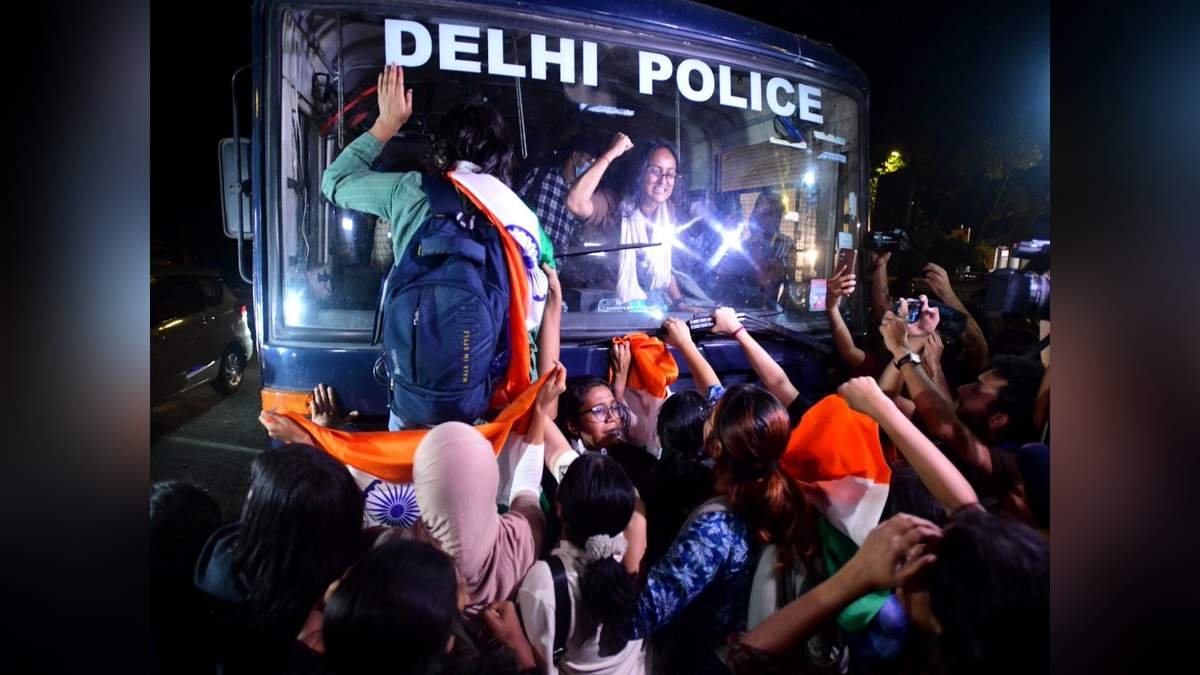
Protests demanding the removal of Chief Election Commissioner Gyanesh Kumar continued in New Delhi on Sunday, 11 October, despite the extensive police deployment and the detention of demonstrators the previous day.
CPI(M) and CPI demand Kumar’s removal as protests continue across India
Students’ Federation of India (SFI) [associated with the Communist Party of India (Marxist)] activists and other left-wing student organisations marched from the Rajiv Chowk area towards Jantar Mantar, raising slogans demanding Kumar’s resignation. Police detained more than 100 people during the Sunday demonstrations, according to Indian media reports.
Among those detained was John Brittas, CPI(M) Rajya Sabha MP, who was stopped while speaking to journalists about the police action. Brittas said that security personnel grabbed him by the neck, pinned him to a seat inside a police bus and choked him. He was subsequently taken for medical treatment. He later wrote to the President of India, the Chairman of the Rajya Sabha and the Chief Justice of India seeking intervention and an independent investigation.
The CPI(M) condemned the treatment of Brittas, describing the police action as an attack on democratic rights. The party’s official social-media communications included a video of the MP following his detention.
BJp and RSS (fascist organisation linked with BJP) goons pelted stones at buses carrying female protestors.
CPI(M): Countrywide protests against repression
The latest confrontations followed the major police operation on Saturday, 10 October, when thousands of people were detained as police prevented demonstrators from reaching Jantar Mantar. Senior CPI(M) leaders, including General Secretary M. A. Baby, veteran leader Brinda Karat and Kerala opposition leader Pinarayi Vijayan, and all other members of the Central Committee of the party were among those detained.
In a statement issued on 10 October, the CPI(M) Polit Bureau condemned the brutal repression and called on party units throughout India to organise protests. It stated that the government was using the police to suppress dissent instead of answering questions about the revision of electoral rolls.
The party linked the defence of the right to protest with the defence of voting rights. It called for:
- The removal of Chief Election Commissioner Gyanesh Kumar.
- An immediate halt to the Special Intensive Revision (SIR) of electoral rolls.
- Restoration of the names of eligible voters allegedly removed from the lists.
- Countrywide mobilisation against the police crackdown.
The CPI(M) statement said the restrictions on movement, barricades and treatment of detained activists constituted an assault on constitutional freedoms.
CPI condemns the detention of Annie Raja
The Communist Party of India (CPI) also condemned Sunday’s police action. CPI National Secretary Annie Raja was detained alongside activists from the All India Students’ Federation (AISF) and the All India Youth Federation (AIYF) as they marched towards Jantar Mantar.
The CPI described the detention and manhandling of Raja, together with police action against AISF and AIYF activists, as unacceptable. The party’s position places the issue within a wider dispute over freedom of assembly and the independence of constitutional institutions.
The CPI has joined the CPI(M) and other opposition parties in demanding Kumar’s removal and a halt to the SIR. It has also called for greater transparency in the electoral process, arguing that the controversy over voter registration and deletion threatens confidence in the Election Commission.
Dispute over electoral rolls
The immediate political issue is the Election Commission’s Special Intensive Revision of electoral rolls. CPI(M), CPI and other opposition parties argue that the process risks excluding eligible voters and have questioned the Election Commission’s independence and handling of the revision.
Opposition parties have cited the possible removal of more than 130 million names from electoral rolls as a central concern. This figure forms part of the opposition’s claims about the scale of the problem; it should not be taken to mean that every name concerned represents an eligible voter wrongly excluded.
The BJP and the Election Commission reject allegations that the revision is politically manipulated. They maintain that the exercise is intended to identify duplicate or ineligible entries and ensure the accuracy of electoral rolls.
The dispute has consequently expanded beyond Kumar personally to encompass voter registration, institutional accountability and the right to demonstrate against the Election Commission.
Protests spread beyond Delhi
Sunday’s demonstrations were not confined to the capital. There were smaller protests in Mumbai, Kolkata, Panaji and Pune, with student organisations and left-wing activists among the participants.
In Pune, police detained around 80 people at a demonstration demanding Kumar’s resignation and the discontinuation of the SIR. Protesters criticised the restrictions as an infringement of their right to peaceful assembly.
These developments show that the campaign has continued through student organisations, left-wing groups and a broader opposition mobilisation, even as police have repeatedly prevented gatherings from reaching their intended venues.